These days, architects are versatile in reclaimed wood, pallets and sustainable means of construction - like the crates our parents used as bookshelves when we were kids or the pallets used by permaculture gardeners to build city allotments today - : pioneers of situationist architecture, Exyzt, Collective ect., Raumlabor, Constructlab use collective involvement and flexible, low-tech material.
 © Exyzt
In Portugal, in Guimaraes, Exyzt is leading construction workshops for Fine art and Architecture students using traditional ways of building. Students are not sitting behind computers but building a crafted platform, with bespoke chairs, to be used for a Laboratorio de Curadoria. The platform is built in a way that puts the human hand and the human brain at the centre of architecture : the design doesn't rely on machines here.

 © Collective etc., La piscine [taken from Collective etc. web page]

© Collective etc., Marseilles - Le Panier's area nomadic workshop [taken from Collective etc. Facebook page]
In Grenoble, Collectif etc. runs collective workshops, at La Piscine, empowering locals to 'self-build' low-cost, DIY furniture, investigating for a better habitat. In Marseilles, they bring the nomadic urban intervention to the residents of Le Panier, using wooden pallets, to share concerns about the regeneration of their neighborough.
Constructlab (Build your own shelter, intervention in Annecy's Art & Design school) or Raumlabor similarly use crate-looking planks as staircases, viewing-sitting platforms, partition-walls, to host temporary community projects. Raumlabor's ingenious design (workstations and chairs) encourages viewers to 'learn by doing', by building collectively.
The collective also explored the idea of 'sustainability' by pilling up discarded furniture, doors and windows at The big crunch.
 © Raumlaborberlin [taken from Raumlabor's web page]
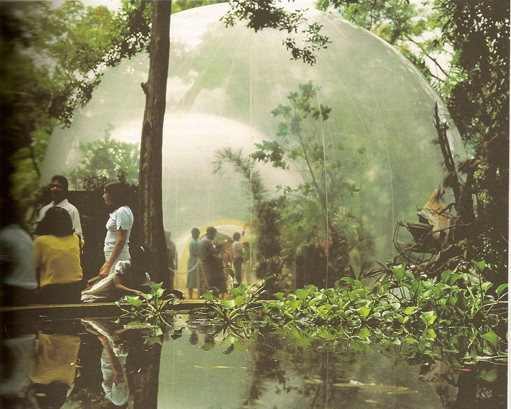
In 2010, Oikos proposed to re-use reclaimed wooden planks and pallets to build The Jellyfish Theatre. 'Focusing, on energy-efficiency, co-operation and human-scale', creating performative and temporary constructions, making space and giving space (back) to the community.
© Raumlaborberlin [taken from Raumlabor's web page]
In 2010, Oikos proposed to re-use reclaimed wooden planks and pallets to build The Jellyfish Theatre. 'Focusing, on energy-efficiency, co-operation and human-scale', creating performative and temporary constructions, making space and giving space (back) to the community.
© Oikos project [taken from Oikos flickr]

© Raumlaborberlin
In Raumlabor's apocalyptic scenarios, capitalism and global litter threaten mankind survival; a temple of discarded doors and chairs is crawling towards the Darmstadt's Theatre to fight/ escape, the imminence of a disaster.

© Raumlaborberlin
It echoes the Merzbau, when Kurt Schwitters transformed his home into an expansion which was growing vertically and out of control. Here the threat is still global : will humanity use its creative power to rise out of chaos or will the sterile processes of our political and economical world swallow the Earth until space reverses onto itself ?

© Raumlaborberlin
Built from the left-overs of mass-consumerism The Big crunch investigates new social territories, expands organically from inside out, assembles domestic rubbish to create a physical space for social gathering.

© Raumlaborberlin/ photo © Max Tomasinelli
Same alternative at the House of contamination, an architectural model for Artissima's cultural centre and indoor city. By skillfully piling-up the leftovers of mass-consumption (plastic bottles, packaging, advertising papers, fabrics ...) to create the skeleton of the House, the walls reveal layers of trash like archeological stratas of the present.

© Raumlaborberlin/ photo © Max Tomasinelli
We are invited in the Palace of our rubbish : there litter holds the potential to shelter us, fridges are book shelves and rejected clothes cover the floor of a garage. A corridor bathed by a breeze gently opens and closes parts of a translucide curtain, where compartimented areas host a program of dance, urbanism, cinema, education, litterature, design.

© Raumlaborberlin/ Max Tomasinelli
The Skywall which dominates the whole of the architectural intervention acts as a tolerant type of panopticon : anyone can place himself or not in the tower of control, but can't intervene on what is happening in the rooms of the first floor.
Overlooking the city from this observatory platform, we face the reality about its potential future : if we all control the machine, how to make it run now ?
© Raumlaborberlin © Max Tomasinelli
When materials, people and programs collide, interesting moments of ambiguity and tension lead to negotiations over needs, desires and purposes, and hopefully allow new forms of collaboration to develop. We consider this negotiation process an essential part of the production public space. New forms of collaboration spark the hope for a different and better world, for a human overcoming of the endzeit scenarios. Again the future is uncertain. Let’s contaminate radical individualism. Collectively is not a choice, but a necessity.
Raumlabor

 Terrasse-platform, St-Jean-en-Royans, 2010 © Exyzt © De L'aire/ Photo © Emmanuel Gabily
For De L'aire's residency, Chaux Devant, Exyzt gives a Terrasse-platform, an alternative to HLM halls where children meet and chat, an enclosed bench and decking area as a response to the cementing of play areas in the city and to reinforce convivial space.
 Chaud devant, St-Jean-en-Royans 2009 © Exyzt
The second residency, Chaud Devant ! gives the community a meeting point, a hot spot to share stories and a pizza by the warmth of an oven on wheels. The mobile oven and the terrasse-platform are built out of wooden planks which mirrors the village's past wood industry and the inhabitants' involvement as work force in its factories.

Les Fougeres, 2009-2011 © Exyzt © De L'aire/ photo © Emmanuel Gabily
With the third residency, Exyzt is assembling an Autonomous Space from the leftovers of the HLM Les Fougeres' demolition : doors, windows, bathtub ... to build a Kiosk for the community.


Haus der Vorstellung, P2 residence, 2008 © raumlaborberlin
For the P2 residency, Raumlabor mapped the Haus der Vorstellung, a typical mass produced flat in Berlin and overlapped it with a "government-controlled" type of living space (Plattenbau, P2). While the first type of flat was delimited using white masking tape, the second was constructed in 3D using a collection of discarded doors re-cycled into furniture.

© raumlaborberlin
The political transcending of an alienating environment meets a poetic mise-en-abime : playing with conventional architecture by accumulating spaces that mirror each other, making the subversive contrast. Creating space for poetry challenges common urban practices and rethink the concept of housing estates.
The floor mapping strangely echoes archeological plans in its highlighting of superposed rites - when mapping superposition retraces different eras and practices.
The project investigates the Present political context in the way the Situationists used to - the "derive" and escapist wish put in practice here recalls Guy Debord's psychogeographical relief.

White spots, Munich
2006 © Raumlaborberlin
White spots also disrupted the normality of a residential area of Munich. During that playful performance, a group of thirty three cars drew unforeseen white lines along the sides of deserted streets. The awareness created by the transformation of a daily perception, the boring repetitiveness of urban ghettos, provoked conflicts between the artists and the locals.
Thanks to Heike Pauketat
The way out of the Situationists was not to wait for a distant revolution but to reinvent everyday life here and now. To transform the perception of the world and to change the structure of society is the same thing. (...) They therefore tried to construct situations which disrupt the ordinary and normal in order to jolt people out of their customary ways of thinking and acting.
Demanding the impossible, A history of Anarchism, Peter Marshall, 1992, Fontana Press [p.551-53].
 C.R.A.S.H contigency © Lab of ii
In the summer of 2009, during the Two degree festival, a series of art events and installation urgently concerned with climate change and involving the public, the artist Richard Dedomenici landed a fake-aircraft in the courtyard of the Arts Admin studios.
Plane food cafe © Richard Dedomenici
After boarding in the Plane food cafe, passengers were encouraged to quickly eat a blend veggie curry - straight from London City airport -, while gazing at a movie showing pigeons being accidently smashed by aircrafts. Not so tasty but as fast and effective as flying and eating can be.

 C.R.A.S.H contigency © Lab of ii
In the evening the Laboratory of insurrectionary imagination invited its viewers to self-conduct a radical happening in the middle of the City.
After voting a set of actions by consensus-making, in the spirit of Reclaim the streets and the Climate Camps, they headed towards Square miles equipped with wheelbarrows and plants donated by local permaculture growers.
In the middle of Spitafield market, an area recently turned into a Business mecca with CCTV 24 hours surveillance, our crew somehow devised to set up a temporary camp with fully functioning kitchen.
When the police finally came, the initial passive aggressive imperative to evacuate turned into a more friendly chit-chat around some freshly brewed elderflower tea, and as they left gifted with individual potted plants, it seems as if even them had joined in the party.
Energy cafe, Gunpowder park 2009 © Pilot Publishing
Later that summer, we also went to build a stage in the wild with Pilot Publishing. Their Energy Cafe was more than a resource on renewable energy and sustainability which transformed Gunpowder Park into a Temporary Autonomous Zone.
The landscape was reclaimed as common space as locals were invited to forage plants from the surrounding wilderness : anyone who joined could cook by the fire and eat under the stars by the sound of music.