Showing posts with label Society of Surveillance. Show all posts

1 February 2013

The watchers being watched

Untitled (Predators; Indian Springs, NV), 2010, C-print © Trevor Paglen, Courtesy of Galerie Thomas Zander, Cologne and Altman Siegel Gallery, San Francisco.
Untitled (Predators; Indian Springs, NV) © Trevor Paglen © Galerie Thomas Zandler

A monotonous sky is interrupted by a blurry aircraft on its left corner; a forest landscape spreading wide in the horizon reveals scintillating but undefined architectural objects in its middle part. 
The main intrigue in Paglen's photographs comes from their distant viewpoint : what are we watching ? where is the scene taken from ? where is the viewer positioned in relation to the event ? 
Who is watching what ? 

They watched the moon © Trevor Paglen © Altman Siegle gallery

The skies photographs Predators reveal the secret activities of Drones : Paglen uses data from amateur satellite watchers to track and photograph classified aircrafts - spy satellites and predator drones -, photographing them photographing him, watching those who are watching us as he puts it.
In They watched the moon, a super strenght telescope reveals a 'listening station', a top-secret U.S. governmental site, a covert base so remote it cannot be seen by unaided civilian eye from any point on earth.
Physical intersection between Earth and the Universe, the station listens to communications from the Earth as they escape towards the moon and bounce back towards the Earth, in an auditive mise-en-abyme. 


12 January 2011

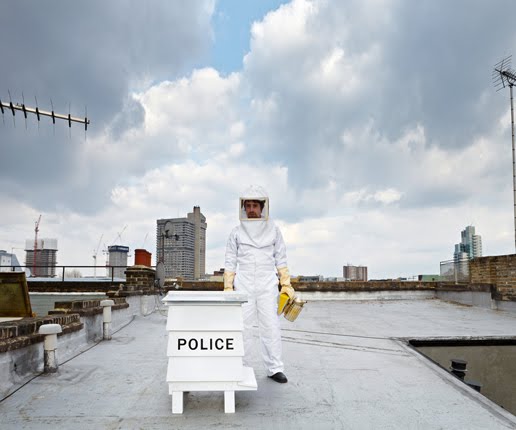
The Bees' Police


Policing genes - 2010 © Thomas Thwaites


Policing genes, futuristic project of designer Thomas Thwaite, is funded by the Centre for Security and Crime Sciences to stop illegal and unlicensed pharmaceutical drugs being grown from genetically modified plants. Thwaites attended a crash course in Synthetic Biology and now anticipates that since it is easy to download DNA sequences from the internet, and insert the genes of one plant into another, the average gardener can potentialy transform broad bean into an hybrid with the DNA of cocaine.


© Thomas Thwaites

These possible futures are influenced by the current laboratories experiences on tomatoes that produce a vaccine for Alzheimer's disease, or potatoes that immunize against Hepatitis B. To help the London Police, using roof beehives, Thwaites has thought of using the genius of bees hunting for pollen to detect the producing of illegal plant-made-pharmaceuticals : what more efficient police than the bee which goes everywhere - indoors and outdoors - with little noticing ? Policing genes implies there is no limit to city surveillance and state control.


Video on display at the 
Wellcome Collection, projects created for the Design Interactions department at the Royal College of Art, offering an alternative view on how science could influence our future, inspire debate about the human consequences of technological futures, both positive and negative.


10 January 2010

Chasing Napoleon

Chasing Napoleon, Palais de Tokyo, 2010


Unacabine (and the original in an FBI basement) © Kusmirowski

Why is Theodore Kaczynscki's manifesto Industrial Society and its Future, kept secret by american services alongside his memoirs ? what frightens so much the american system now he is strictly isolated under police control ?
To understand america's public ennemy,The Unabomber Book Collection by Dora Winter's collective builds up the escapist strategies while Robert Kusmirowski's Unacabine give existence to Kaczynski's flee into the wild.
The presence of his shed in the gallery space of The Palais de Tokyo challenges its legitimity : w
hat makes the difference between the shed he lived in, the lived object, and the fake one ?

The door that asks to be opened, the incapacity to enter, deepen the mystery : the enclosed house encapsulates the uncanny nature of radicalism and extremism as a choice of life, freezing a time forever gone and inaccessible so that Kaczynski's motivations remain terra incognita, his borderline personality won't be framed.
The imperceptible nature of truth, frontiers between real and unreal, are reinforced by an empty plinth on the side of the shed where Thomas Friedman has placed A curse. The aura of the shed and the invisible malediction mirror each other's faith in the tangibility of the unseen.


Spider Hole © Christoph Buchel © Dazed & Confused  

Further away, we can climb inside Christoph Buchel's Spider hole and experience how to hide - like Saddam Hussein. 
Through the exhibition, escapists flee via devices - shed, hole, airvent, drain -, remain invisible from surveillance and control.

ryan-gander-nathaniel-knows-2003-2009-materieux-divers2
Nathaniel knows © Taro Nasu © Ryan Gander

Their disappearance suggests the existence of parallel dimensions : Ryan Gander breaks into the Palais de Tokyo as if coming from
an heterotopia of wilderness, a lost hedonist paradise as the title Nathaniel knows suggests (Andre Gide, Les nourritures terrestres). 


Vorkuta © Micol Assael © Andre Morin

After the critical reference to american capitalism and Napoleon's imperialism, Micol Assael's re-enactement of a communist gulag mirrors the collapse of all systems : in the absence of the worker, Vorkuta's engine is empty of its potency and those who stood in the way of the regime have disappeared.

With Paul Lafolley who explores spatial dimensions, the escape from the constraining boundaries is total. Utopia becomes a suspension between the possible and the impossible, the invisible - or para-normal - recalls the existence of multivers and their "total non-existence". When he affirms having temporary left our physical world during an electroshock in 1961, it somehow reflects Kaczynski's enforced mind control during his C.I.A. funded studies as we wonder how much the stress tests impacted on his sanity.
The chosen year 1977 - that according to the Palais de Tokyo refers to a time when the Unabomber survives by himself in his cabane in the Montana, or when Paul Laffoley finishes his odyssey, refers above all to a time zero - the birth of punk -, an apolitical, subversive dimension and collapse of values.
Now if we go back to the beginning of the show,
For the dogs (...) a prelude for piano by Erick Satie and David Allen is being played on such high frequency that it can't be heard by human ear : a sound piece, and a wave field that we didn't perceive, which does exist outside our realm of senses.