Showing posts with label Anthropocene. Show all posts

27 September 2013

Fox diner

Fox diner © Niusia Winczewska

Niusia Winczewska's photographs of Fox diners bring an instant feel of familiarity. Her deserted London streets filled with cheap food cafes recall typical neighboroughs of the East-end without the rubbish scattered around. 
On the pavement, a wooden box mimics the stores in the background : inside are two bowls in which passers-by can share their food scraps with foxes. 


Dark Mountain: Issue 1
Dark Mountain issue 1

In her statement, Winczewska is keen that the focus of sustainability is the preservation of Life, all Life.
Not that it is her intention but it brings to mind what Dark mountain exposes in the manifesto Uncivilisation about the impact of the Anthropocene on the planet (now is not a time to mourn the extinction of the human civilisation but a time to focus on wildlife protection; on saving the last species of the plant and animal world which can be saved).
At the contrary somehow, Winczewska's design bridges the gap between human and animal, domesticated and wild. 
Inciting gestures of kindness from one specie to another, the box becomes a catalyst of urban wilderness; the fox, which status moves from pest to cleaner, becomes more visible. 
Let's just wish that wild species will not feed on junk-food left-overs or need to help humanity to be more regarded.


Howl - The Altered Landscape © Amy Stein


For now Winczewska's concept goes beyond the radical views : by not investing in prophetic outcomes, focussing on steps for the sustainability of all species, it provokes narratives of hope and further encounters in the night.


Thanks to Niusia Winczewska


27 October 2011

I'm lost in Paris


http://farm4.static.flickr.com/3301/4582032551_d85d3ac356_o.jpg
I'm lost in Paris © R&Sie(n) 

I'm lost in Paris questions and provokes fantastic scenarios : can a forest grow overnight unnoticed and swallow a city ? 
How long would it take nature to destroy the concrete jungle and force us back into a feral state of being ?
R&Sie(n)'s interventions explore our disconnecting from Nature, question architectural and human behaviour : why do we cement the  land ? Why do we pesticide the soil in order to eat ?


Streamside day © Pierre Huygue


And why do we do romanticise Nature, thinking it needs saving ? 
The natural world is in constant metamorphosis for its own survival and the maintenance of plant and bacteria expansion : Nature doesn't need saving but we do.
The fern used to grow I'm lost in Paris is a good example of plant world resilience : it species existed before the human race, 360 million years ago. 
Its rapid and aggressive nature recalls Kudzu, a plant which survives pollution, fire and lack of nutrients by sprawling over cars, streets, houses or entire landscapes.


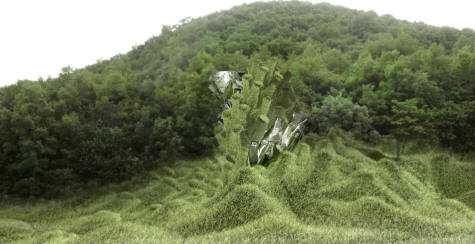
Symbiosis'hood  © R&Sie(n)

The transformative structural nature of Kudzu which inspired R&Sie(n) to build Symbiosis'hood in Korea blurs the boundaries between two properties as the invasive plant is slowly covering the spatial areas that originally delimit where one property starts and another ends - exposing how Nature reclaims land regardless of human contingencies.


I'm lost in Paris © R&Sie(n)

I'm lost in Paris is a façade for a city laboratory, exploring the way ferns protect the environment from heat and control pollution. 
Despite soil and with little water, the hydroponics experiment has managed to grow thousands of them while the glass grapes clean up the air from pollution composing with nature by adapting.   
Nature can't be domesticated : architects need to validate the inter-dependence between the human world and the animal/ plant world.
We may not stop the consequences of the Anthropocene but by composing with the natural world we may find our place in it, and hopefully save ourselves and some species. 


1200 Hydroponics ferns - a method of growing plants using mineral nutrient solutions, without soil
300 glassblown "grape-drops" beakersPhytoremediation - the science of using plants to help clean up pollution