Showing posts with label Altered landscape. Show all posts

30 June 2014

The village of hope


Saihate eco-village © 2013 Kien Hoang Le/ Agency Focus

Following Fukushima's tsunami in 2011, the Kosakai family moves out of Tokyo to the southern island of Kyushu. 
On a hilly ground amidst orange/ citrus trees overlooking the sea, with the help of a few friends, they build the eco-village of Saihate, using the emergency of the post-nuclear era as catalyst to connect with a biological lifestyle.


© Hiroshi Manaka


Saihate village - building site © http://livingpermaculture.blogspot.co.uk/p/about.html

With their organic volumes, some of the living spaces remind Nader Khalili's Earth dwellings, using the superadobe technology, a mixture of sand bags and earth. 


Superadobe technology © Calearth.org

The dome is being raised by digging earth underneath the ground to re-use it as building material, reducing the need for transporting goods. 
Earth dwellings require low technical skills so that the all family can participate to the building process.  


Saihate eco-village © 2013 Kien Hoang Le/ Agency Focus

In the same eco-process as Michael Reynolds's Earthships, tyres are used to structure the outer membrane of the building, saving the environment from the accumulation of non perishable (and highly available) waste.  


Saihate eco-village © 2013 Kien Hoang Le/ Agency Focus


Beyond the survival endeavour, Saihate eco-village also is a creative/experimental/musical project : you can see more here


Saihate village - Rocket stove and tatami © http://livingpermaculture.blogspot.co.uk/p/about.html


27 September 2013

Fox diner

Fox diner © Niusia Winczewska

Niusia Winczewska's photographs of Fox diners bring an instant feel of familiarity. Her deserted London streets filled with cheap food cafes recall typical neighboroughs of the East-end without the rubbish scattered around. 
On the pavement, a wooden box mimics the stores in the background : inside are two bowls in which passers-by can share their food scraps with foxes. 


Dark Mountain: Issue 1
Dark Mountain issue 1

In her statement, Winczewska is keen that the focus of sustainability is the preservation of Life, all Life.
Not that it is her intention but it brings to mind what Dark mountain exposes in the manifesto Uncivilisation about the impact of the Anthropocene on the planet (now is not a time to mourn the extinction of the human civilisation but a time to focus on wildlife protection; on saving the last species of the plant and animal world which can be saved).
At the contrary somehow, Winczewska's design bridges the gap between human and animal, domesticated and wild. 
Inciting gestures of kindness from one specie to another, the box becomes a catalyst of urban wilderness; the fox, which status moves from pest to cleaner, becomes more visible. 
Let's just wish that wild species will not feed on junk-food left-overs or need to help humanity to be more regarded.


Howl - The Altered Landscape © Amy Stein


For now Winczewska's concept goes beyond the radical views : by not investing in prophetic outcomes, focussing on steps for the sustainability of all species, it provokes narratives of hope and further encounters in the night.


Thanks to Niusia Winczewska


15 January 2012

Decolonizing architecture


Decay, migrant birds, wild nature taking over urban architecture, reclaiming the site on behalf of the birds, spatial narratives of the conflict zones.

Decolonizing Architecture 
The book of migration 
Courtesy: the artists

The Book of Migration © Alessandro Petti, Sandi Hilal, Eyal Weizman


13 July 2009

Radical Nature


Agnes <span class=
Wheatfield, a confrontation - 1982 © Agnes Denes

Radical Nature at the Barbican Centre explores Art and Architecture in a changing planet, maybe suggesting that our relationship to the natural environment is one determined by a form of activist engagement. 
Outside the gallery, Agnes Denes's pioneer guerrilla gardening, a Wheatfield which was once staged on a disused site in Manhattan, is this time erected on a disused site in Hackney.


© Exyzt collective flickr

The architectural collective Exyzt is given the task to build a Mill to go with the field which turns out to be the highlight of the show as the collective builds up audience and local interaction. 

© Exyzt collective flickr

Inside the gallery, the focus is on eco-design, survivalism, experimental architecture, utopianism, physical science amongst others, showing artists of different eras and preoccupations together.

Contemporary Arts Center presents Green AcresSurvival Series #6 - 1973/2009 © Harrison Studio © Lyndon Douglas 

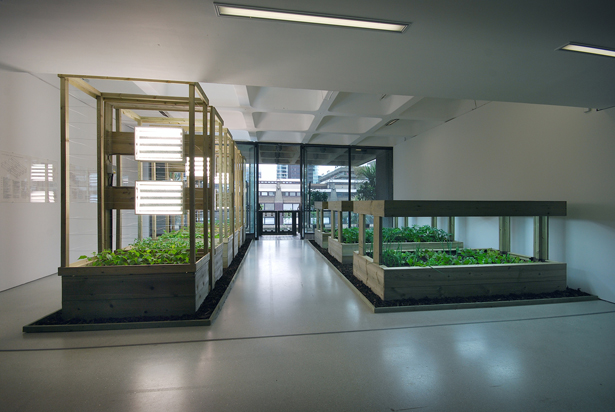
In the first room, Survival series, a line of raised beds by Harrison studio, explores farming awareness or how biodiversity opposes to monoculture-farming. 
This is where we expected to hear about permaculture farming, such as the work of Fukuoka and his Straw revolution but there is no mention of radical gardening, in fact the show doesn't even engage with activist/artistic practices that overlooks nature in urban contexts today.

one-straw
© Larry Korn and Masanobu Fukuoka

Further away, when showing the work of Joseph Beuys, there is no mention of his connection to food, land and gastrosophy.
While Beuys's multi-layered mythology is installed in a complexified manner, there is no focus on his environmental engagement.


In other parts of the show, the interest comes from projects inspired by biomimicry : foam bubbles are re-used by Buckminster Fuller for his geodesic structures and by Thomas Saraceno for his Airt-Port-City, mineral accretion mirrors coral reefs in Wolf Hilbertz' ecological city, Ant Farm, with its visionary Dolphin Embassy, aspires towards inter-species communication.

Dolphin Embassy - 1974-78 © Ant farm [taken from Spatial agency web page]

Finally, one image from the Center for Land Use Interpretation does hint at what Art and Architecture in a changing planet meant to expose : the picture which scale fully emerges the viewer, shows a bird's eye view of an Alaskan pipeline cutting across miles of wilderness, forcing awareness on the way the planet is being dramatically re-shaped by human hand.

272
Alaskan pipeline © CLUI


5 January 2009

Spot 79


Spot 79 - 2009 © Analucia Feracci

Spot 79 is a walking garden which is temporary growing in a Permaculture centre. The plankton observed in the garden survived an oil spill in sea waters. Part of many unusual phenomenons provoked by human pollution, this new form of life relates to the red water cancer, an invasion of killing algae that asphyxiate all sea life.


Spot 79, 2009 © Analucia Feracci

The plankton slowly gave life to a colony of crustacean-algae : the plants came to life, moved around, getting closer to one another.
As the garden became a place for observation, it opened onto other experiments influenced by the social life of plants like The Garden in motion and the third landscape observed by botanist Gilles Clement. 
It echoes the vibrations of plants and wildlife intelligence which Jeremy Narby explores in Intelligence in nature and Cosmic Serpent : DNA and the Origins of Knowledge; to summarise, the transmission of (molecular) knowledge between plant species and Amazonian Shamans.