Showing posts with label Radical nature. Show all posts

29 February 2012

H.O.R.T.U.S.


At the exhibition opening, the ''garden'' was full of people of all ages relaxing by it or under it and moving through it. Visitors were vocal on the significance of putting algae into an architectural system.
  © H.O.R.T.U.S by ecoLogicStudio 

The members room at the Architecture Association looks cyber-exotic with its vivid green apple carpets and 300 intra-venous bags hanging from the ceiling : mimicking the blood of an urban ecosystem, the bags hold nine shades of green from different kind of algaes.
The concept of H.O.R.T.U.S. (Hydro Organism Responsive to Urban Stimuli) appears technical or confusing (read here) but is simple : while blowing into plastic bags, viewers create enough CO2 to sustain the oxygen needed to produce algae organisms. The bags possess a QR code that visitors scan to find which algae they are producing. By helping it grow, they become part the garden.


© H.O.R.T.U.S by ecoLogicStudio

EcoLogicStudio quotes Gilles Clement as introduction to its eco-garden - 'If we look at the earth as a territory devoted to life it would appear as an enclosed space, delimited by the boundaries of living systems [the biosphere]. In other words it would appear as a garden' - as for Clement, the 'Symbiotic man', is an actor of the 'Planetary Garden' and its task is to find out 'How to exploit diversity without destroying it ?'. Clement conceives the environment as a place of constant 'recycling of energy with no accumulation of waste other than decomposable organic matter'. Somehow, this is what  H.O.R.T.U.S. explores by inviting viewers to give life to the mini ponds of an algae farm.


© H.O.R.T.U.S by ecoLogicStudio

The greenhouse cohabits with a virtual garden that feeds on visitors' scans and tweets about the exhibition but we don't need this association to grasp the idea that the garden is connected to the viewer and the garden to the viewer - thus the initial confusion : the fact that we participate to the biosphere's expansion, is an idea already embedded in the work.


14 July 2009

I am so sorry. Goodbye


© Heather & Ivan Morison

I am so sorry. Goodbye by Heather and Ivan Morison has been transported in the middle of the Barbican estate for Radical Nature, Art and Architecture in a changing planet.
Made of wood harvested from fallen trees and assembled piece by piece, it forms a pentagonal structure reminiscent of Buckminster Fuller's survival constructions.
The shelter confronts our future as it is a spaceship to board in case of a disaster. Its title refers to mis-communication between locals and visitors of foreign countries, the work opening here onto a prophetic ecological failure.


Journee des Barricades 2008 © Heather and Ivan Morison

Journee des Barricades, another Morison's project, borrows from activist practices to mention the ecological failure making the citizens of Wellington spectators of a fantastic tsunami of rubbish.
Collecting garbage from derelict areas of the city and involving viewers in its re-appropriation would reflect on possible alternatives but 'borrowing' garbage from recycling areas - meaning complex logistics and environmental non-friendly processes to move tones of garbage - and back again, requiring more negotiations with the authorities than "disruption from the city traffic"* can be seen as symptomatic of the failure.


© Heather & Ivan Morison

Land of Cockaigne, another project, shows kilos of flowers being given away as graceful, hedonist gesture : with its observational platform, the work seems to denounce the flower industry - flowers grown in third world countries by western industries that overuse local land and local food potential. 
As its viewers are eager to grab as much as they can, it swaps the laws of luxury for complacent generosity, turning Land of Cockaigne into a performance more concerned with human failure than activism.


* Dorita Hannah, Ivan and Heather Morison, Journee des Barricades - a critical response, Massey university, Litmus research initiative, 2009.

13 July 2009

Radical Nature


Agnes <span class=
Wheatfield, a confrontation - 1982 © Agnes Denes

Radical Nature at the Barbican Centre explores Art and Architecture in a changing planet, maybe suggesting that our relationship to the natural environment is one determined by a form of activist engagement. 
Outside the gallery, Agnes Denes's pioneer guerrilla gardening, a Wheatfield which was once staged on a disused site in Manhattan, is this time erected on a disused site in Hackney.


© Exyzt collective flickr

The architectural collective Exyzt is given the task to build a Mill to go with the field which turns out to be the highlight of the show as the collective builds up audience and local interaction. 

© Exyzt collective flickr

Inside the gallery, the focus is on eco-design, survivalism, experimental architecture, utopianism, physical science amongst others, showing artists of different eras and preoccupations together.

Contemporary Arts Center presents Green AcresSurvival Series #6 - 1973/2009 © Harrison Studio © Lyndon Douglas 

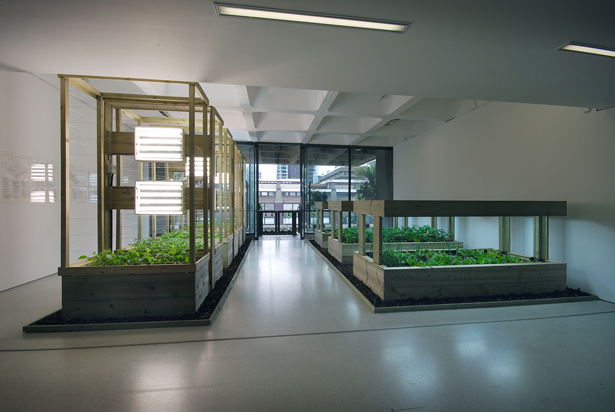
In the first room, Survival series, a line of raised beds by Harrison studio, explores farming awareness or how biodiversity opposes to monoculture-farming. 
This is where we expected to hear about permaculture farming, such as the work of Fukuoka and his Straw revolution but there is no mention of radical gardening, in fact the show doesn't even engage with activist/artistic practices that overlooks nature in urban contexts today.

one-straw
© Larry Korn and Masanobu Fukuoka

Further away, when showing the work of Joseph Beuys, there is no mention of his connection to food, land and gastrosophy.
While Beuys's multi-layered mythology is installed in a complexified manner, there is no focus on his environmental engagement.


In other parts of the show, the interest comes from projects inspired by biomimicry : foam bubbles are re-used by Buckminster Fuller for his geodesic structures and by Thomas Saraceno for his Airt-Port-City, mineral accretion mirrors coral reefs in Wolf Hilbertz' ecological city, Ant Farm, with its visionary Dolphin Embassy, aspires towards inter-species communication.

Dolphin Embassy - 1974-78 © Ant farm [taken from Spatial agency web page]

Finally, one image from the Center for Land Use Interpretation does hint at what Art and Architecture in a changing planet meant to expose : the picture which scale fully emerges the viewer, shows a bird's eye view of an Alaskan pipeline cutting across miles of wilderness, forcing awareness on the way the planet is being dramatically re-shaped by human hand.

272
Alaskan pipeline © CLUI


20 April 2009

Beezome


Beezome - 2008 © Analucia Feracci - plant based pigments, sourdough starter, fur, wooden sticks, Epping Forest clay @ The Hornbeam Permaculture centre/ wall installation dedicated to Organiclea

Beezome shows underground threads linking independent communities in East London. 
It works as a mind mapping system of Temporary spaces and Pirate Autonomous Zones(TAZ/PAZ) in this specific area of London.
It visually highlights a rich and detailed network of people, from Permaculture activists to unschooling families, and how underground communities exchange skills creatively, in a non hierarchically manner. 
It also works as metaphor for the bee pollinating the flower : a bee that drinks the nectar of the flower is no longer a bee but 'a bee-becoming-flower', while the flower in return, by disgesting a system of vital information, becomes the bee.