Showing posts with label New territories. Show all posts

1 November 2017

A secret oasis in the desert


Los Molinos del Río Aguas Photos © Analucia Feracci

The off-grid village Los Molinos del Río Aguas in Andalucia is a little miracle, an oasis of biodiversity in the middle of a rocky desert : its valley appears dry and inauspicious from above but becomes more green and lush as we reach the river bed.


Photos © Analucia Feracci

Thanks to the Rio Aguas that runs through the Tabernas sub desert (considered the most arid region of Europe), here the valley transforms into an oasis of trees, cactus and agaves, making it a unique observational platform for eco-alternative futures.


Photo © Analucia Feracci

With its unexpected forest of Eucalyptus, Silver birches and White poplars and its river bed of Pampas grass and Reeds, this part of the valley stands out from the rocky surroundings, visually affirming that Water is Life, that water is sacred.


Thanks to an irrigation and sewage system dating back to the roman ages, the village that nests in the valley is also blooming with Pomagranates, Lemon and Fig trees, while the river contributes to maintain a vibrant fauna and flora, hosting endemic flower species and freshwater spur-thighed tortoises, species that don't exist anywhere else. 


Photos © Analucia Feracci


Photo © Ion Holban


The presence of underwater storage helps the valley to flourish : that water springs from within the Gypsum Kart rock formations as it was pointed out to me by environmental activist Jorge Blanco Abad.


The water is then redistributed via an ingenious pumping system, an hearty device that supplies for the village needs so that vegetable gardens can survive desertification.


Photos © Analucia Feracci


Today, an intensive culture of millions of genetically modified olive trees grown in plain Tabernas desert is pilling the water of this Aguas Aquifer, draining underground water - a method of extraction considered has mining as it extracts fossil water. 


As this water is the only local source to the whole area and this agro-industry requires an impressive amount of water, the plantation is simply stealing water from the local population.


As Jorge Blanco Abad pointed out, we can observe this phenomenon in the river : where water lines have left their marks, the rocks stand as witness of the lowering of water levels (in 2014, the water flow in the cave springs dropped from 70 liters per seconds to 15 liters, leading to desertification).


Photo © Ion Holban


That flow disorder didn't happen because of the drought but comes from the springs. This desertification not only endangers species, killing plants and animals, but also threatens the livelihood of local communities, forcing people to migrate.


This is not news as the village of Los Molinos was falling into ruins following previous displacement of population, it is still being restored by the new locals.


The link between water levels and the massive plantation of olive trees, as well as the future of local communities is also well explained in the following video by environmental activist David Dene.


David Dene is a well-known activist for Amazonian Environmental Rights who has been fighting for years to protect the area del Rio Aguas, acting besides many other activists and water protectors for La Plataforma en Defensa del Rio Aguas y Acuiferos Vivos.


As he told me at his home in Los Molinos, the desertification process has already happened so there is no time left : the oasis is simply disappearing !

Fortunately, the case of the Aguas Aquifer which has been denounced by experts of hydro-geology at Almeria University is now considered as Ecocide.


Nos Roban el Agua © Design by Daniel Torrego for Sunseed Desert Technology 


It will be taken before the International Tribunal for the Rights of Nature at the Bonn COP23 International Summit on the 7th of November 2017 by La Plataforma en Defensa del Rio Aguas y Acuiferos Vivos.


So what should we wish for ?
An intensive plantation of genetically modified olive trees ? 
Or water for the plants, the animals and the inhabitants of this oasis ?
A desert with no water ?
Or an oasis with water  ?


Specials thanks to David Dene and Jorge Blanco Abad


Poderosos grupos inversores, en connivencia con las Administraciones, han plantado millones de olivos en regadío en pleno desierto de Tabernas, Almería. Estos monocultivos superintensivos son regados con aguas fósiles extraídas del Acuífero Aguas, el más sobre-explotado de toda Andalucía (400%), y del que depende el Río Aguas, uno de los pocos recursos hídricos de la provincia, completamente desertificada. 


La grave situación ya está originando problemas de abastecimiento en los núcleos urbanos y aldeas de la zona. Todos los estudios coinciden en que el río se secará completamente en los próximos años, sentenciando a muerte a la flora y la fauna, muchas de ellas especies endémicas, poniendo en peligro los modos de vida sostenibles de la comarca, condenando a sus 35.000 habitantes a la migración precaria y acabando con el Paraje Natural Karst en Yesos de Sorbas.

Recientemente, el canal de televisión europeo "ARTE" y la televisión suiza han proyectado una serie de documentales al respecto. La comunidad internacional se ha hecho eco de la situación y el caso ha sido incluido en el Tribunal por los Derechos de la Naturaleza COP23, para ser juzgado en la ciudad alemana de Bonn el próximo 7 de noviembre.

Dado que la Junta de Andalucía y el Gobierno central se niegan a actuar, hemos decidido salir a la calle para apoyar a nuestras enviadas a Bonn.

Exigimos la revisión y limitación de las concesiones de agua, así como la realización de un estudio hídrico en condiciones.


Convocan: Plataforma en Defensa Del Acuífero del Río de Aguas y Acuíferos Vivos


6 June 2012

The freedom zone


The zone of freedom lives at the edges of wilderness, at the periphery of industrial areas and council estates, along train tracks and desolate lands, in factories and buildings that escape central agendas to become spontaneous playgrounds, and sometimes also on sacred lands.


Free Stonehenge encampment, UK

To implement the control, zoning and conpartimenting of these populations, local authorities abolish the right for free gathering (suppression of the Free festivals) : subcultural nomads are expected to redirect themselves towards the spaces of (state) convenience - the Mall, the Funfair.


Enchanted forest, Texas - 2006 © Alec Soth

But they don't.
Once that breathing zone is reduced by squatting laws or controlled by regeneration politics, some leave for the Never never lands.

[IMG]
The last convoy to Stonehenge - Battle of the Beanfield, UK - 1984

The spaces of play and freedom become flexible, resilient, temporary; communities live in transient mode to avoid the encirclement. 

Morison_04a


The free parties get more organised, less easy to track (endless hunts for remote gatherings, truck convoys at the far ends of western and eastern borders). 

Investigating new lands, new living patterns provoke the context we aim to flee - Michael Reynolds spends as much time by-passing building laws to keep his earthships legalised than building them - but pioneers open the doors to social change. Ignoring the alienation of the state machine, the 60's give birth to resilient architectural practices. 


Archigram's Monte Carlo and Bournemouth Projects - published in Architectural Design, August 1971. Photo: Tatjana Schneider


© Archigram photo © Tatiana Schneider taken from Spatial agency webpage

Buckminster Fuller informs the building of Drop city, a temporary settlement built from scratch, Archigram influences a socially engaged architecture for a playful city. Freedom activists, artistic and intellectual movements investigate new forms of deterritorialization to preserve autonomous zones in the city. 

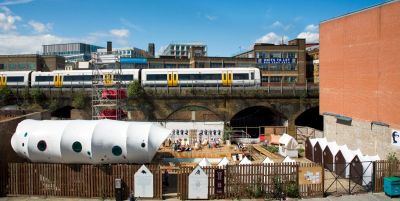
Southwark Lido 2008


Southwark Lido, 2008 © Exyzt / Sarah Muzio 

Architectural collectives like Exyzt devise urban spaces that invest the zones of control : benefiting from a pause in the development frenzy, their events replicate, duplicate, multiply themselves, disappear and re-appear, putting the off-grid back on the map. Their temporary appearances keep political agendas, advertising and consumerism off site while giving space for play and gathering.
At Campo Boario in Roma, Stalker opens a borderless, visa free zone to homeless groups and transitory immigrants. A space that temporarily succeeds to abolish the rules imposed by Shengen (a legal space, 'illegally squatted but legitimised by institutional and media support'). 

In order to escape the societal rules and spatial boundaries of the state, in essence, the zone of freedom remains a fleeting momentum charged with the spirit of now, an urban void filled with shared experiences and memories.


Campo Boario - Roma 1999 © Stalker


29 February 2012

H.O.R.T.U.S.


At the exhibition opening, the ''garden'' was full of people of all ages relaxing by it or under it and moving through it. Visitors were vocal on the significance of putting algae into an architectural system.
  © H.O.R.T.U.S by ecoLogicStudio 

The members room at the Architecture Association looks cyber-exotic with its vivid green apple carpets and 300 intra-venous bags hanging from the ceiling : mimicking the blood of an urban ecosystem, the bags hold nine shades of green from different kind of algaes.
The concept of H.O.R.T.U.S. (Hydro Organism Responsive to Urban Stimuli) appears technical or confusing (read here) but is simple : while blowing into plastic bags, viewers create enough CO2 to sustain the oxygen needed to produce algae organisms. The bags possess a QR code that visitors scan to find which algae they are producing. By helping it grow, they become part the garden.


© H.O.R.T.U.S by ecoLogicStudio

EcoLogicStudio quotes Gilles Clement as introduction to its eco-garden - 'If we look at the earth as a territory devoted to life it would appear as an enclosed space, delimited by the boundaries of living systems [the biosphere]. In other words it would appear as a garden' - as for Clement, the 'Symbiotic man', is an actor of the 'Planetary Garden' and its task is to find out 'How to exploit diversity without destroying it ?'. Clement conceives the environment as a place of constant 'recycling of energy with no accumulation of waste other than decomposable organic matter'. Somehow, this is what  H.O.R.T.U.S. explores by inviting viewers to give life to the mini ponds of an algae farm.


© H.O.R.T.U.S by ecoLogicStudio

The greenhouse cohabits with a virtual garden that feeds on visitors' scans and tweets about the exhibition but we don't need this association to grasp the idea that the garden is connected to the viewer and the garden to the viewer - thus the initial confusion : the fact that we participate to the biosphere's expansion, is an idea already embedded in the work.