Showing posts with label Archigram. Show all posts

6 June 2012

The freedom zone


The zone of freedom lives at the edges of wilderness, at the periphery of industrial areas and council estates, along train tracks and desolate lands, in factories and buildings that escape central agendas to become spontaneous playgrounds, and sometimes also on sacred lands.


Free Stonehenge encampment, UK

To implement the control, zoning and conpartimenting of these populations, local authorities abolish the right for free gathering (suppression of the Free festivals) : subcultural nomads are expected to redirect themselves towards the spaces of (state) convenience - the Mall, the Funfair.


Enchanted forest, Texas - 2006 © Alec Soth

But they don't.
Once that breathing zone is reduced by squatting laws or controlled by regeneration politics, some leave for the Never never lands.

[IMG]
The last convoy to Stonehenge - Battle of the Beanfield, UK - 1984

The spaces of play and freedom become flexible, resilient, temporary; communities live in transient mode to avoid the encirclement. 

Morison_04a


The free parties get more organised, less easy to track (endless hunts for remote gatherings, truck convoys at the far ends of western and eastern borders). 

Investigating new lands, new living patterns provoke the context we aim to flee - Michael Reynolds spends as much time by-passing building laws to keep his earthships legalised than building them - but pioneers open the doors to social change. Ignoring the alienation of the state machine, the 60's give birth to resilient architectural practices. 


Archigram's Monte Carlo and Bournemouth Projects - published in Architectural Design, August 1971. Photo: Tatjana Schneider


© Archigram photo © Tatiana Schneider taken from Spatial agency webpage

Buckminster Fuller informs the building of Drop city, a temporary settlement built from scratch, Archigram influences a socially engaged architecture for a playful city. Freedom activists, artistic and intellectual movements investigate new forms of deterritorialization to preserve autonomous zones in the city. 

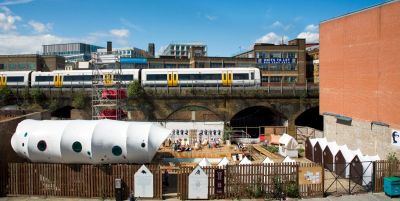
Southwark Lido 2008


Southwark Lido, 2008 © Exyzt / Sarah Muzio 

Architectural collectives like Exyzt devise urban spaces that invest the zones of control : benefiting from a pause in the development frenzy, their events replicate, duplicate, multiply themselves, disappear and re-appear, putting the off-grid back on the map. Their temporary appearances keep political agendas, advertising and consumerism off site while giving space for play and gathering.
At Campo Boario in Roma, Stalker opens a borderless, visa free zone to homeless groups and transitory immigrants. A space that temporarily succeeds to abolish the rules imposed by Shengen (a legal space, 'illegally squatted but legitimised by institutional and media support'). 

In order to escape the societal rules and spatial boundaries of the state, in essence, the zone of freedom remains a fleeting momentum charged with the spirit of now, an urban void filled with shared experiences and memories.


Campo Boario - Roma 1999 © Stalker


22 January 2012

Floating cities


What if New York city ... © Studio Lindfors/ Ostap Rudakevych

Ostap Rudakevych's emergency zeppelins that look like hybrids of an airship and an insect can be deployed other the rooftops of rescued communities while a team of workers fix the damage downstairs. 

Cloud skippers © Gretchen Stump/ Studio Lindorfs


While post-disaster cities, like Cloud cities or Archigram's pods prevent chaos, the Cloud skippers already float beyond the skyscrapers territories : their self-sufficient communities live on green platforms suspended by cables.


Cloud skippers © Rael Sanfratello

Rael Sanfratello pushes the idea further by sending out Floating gardens, inflatable dirigables resembling giant jellyfishes, which transport growing gardens and migrate from one city to another following the seasons.


15 January 2012

Flooded cities


Flooded London © Anthony Lau  

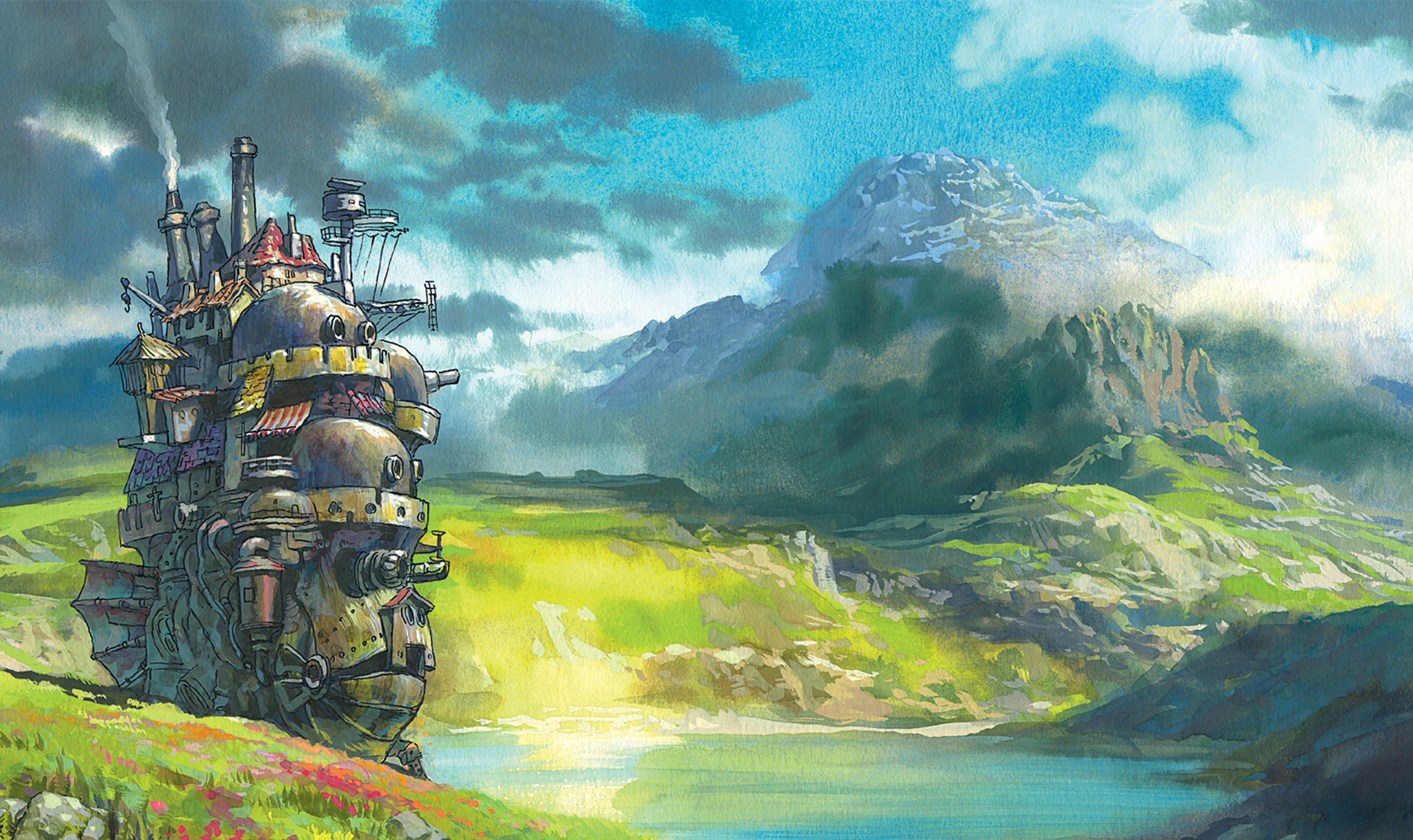
Facing the potential rise of sea levels, Anthony Lau and his idea of living on oil platforms on the London's Estuary concentrates on escapism, relates to space in the same way as Howl's moving castle's transformative home or Archigram's walking city. 

http://evansheline.com/wp-content/uploads/2010/12/howls-moving-castle.jpgHowl's moving castle © Miyazaki 

archigram_klein© Archigram 

Today in Lea valley, those who live on barges can harvest neetle or comfrey from nearby marshlands, cycle to work along river pathways, grow food on nearby allotments and plant nurseries, avoiding the city pavements. 

The image “http://static.dezeen.com/uploads/2009/11/dzn_Aqualta-by-Studio-Lindfors-07.jpg” cannot be displayed, because it contains errors.
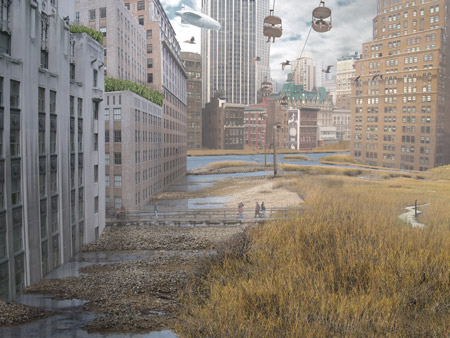
Aqualta © Studio Lindfors

Tomorrow in Tokyo or New York, citizens could transport themselves via gondoles and suspended bridges, acclimatise their agro-system to a wet landscape, inhabit their territories alongside the wildlife and feed on the edible landscape. 
Why not adapting to the sea rise rather than fear its consequences ?

http://static.dezeen.com/uploads/2009/11/dzn_Aqualta-by-Studio-Lindfors-03.jpgAqualta © Studio Lindfors