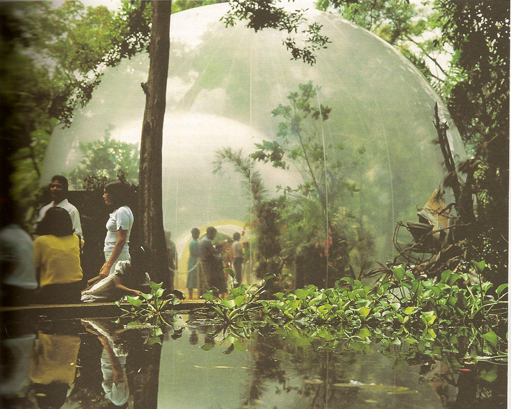
Gilles Clement, Jardin de resistance/ garden of resistance © Gilles Clement
In 2001 in London, Michael Landy famously destroys all of his belongings during an art performance in Oxford street, the mecca of capitalism.
For two weeks, passers-by witness the dismantling of objects that were once part of his life : everything he owns, from his postals to his car, is methodically thrown away.


Michael Landy, Break down, performance, drawing © Michael Landy
Michael Landy, Bin, performance, 2001 © Michael Landy
What happens once we escape a materialistic lifestyle and nearly reach financial break down ? asks his gesture.
At the other end of the black hole that swallowed all of his belongings, Landy summoned his imaginary world and discovered a subtle, delicate garden of common weeds.
Surviving nettles and creeping buttercups found in the streets of London were carefully picked-up, repotted and looked after.
The artist depicted the plants in a series of etchings imbued with poetic simplicity.
In the same manner Break down's title seemed to refer as much to a physical destroying as to a state of mind, the title Nourishment seems to evoke food for the soul here.


Michael Landy, Fewer few/ Creeping buttercup etchings, 2002-2003, © Michael Landy
These 'street flowers', says Landy, are marvellous, optimistic things that you find in inner London ... They occupy an urban landscape which is very hostile and they have to be adaptable and find little bits of soil to prosper.
We can see in the detailed rendering of their rhyzomatic roots, the patient searching for soil, water and nutriment, a mirroring of the artist's quest for spiritual meaning.
Proclaiming the end of one's materialistic lifestyle - an echo of the possible end of capitalism - is life affirming.
The rediscovering of what lives in the margin, of the poor, the discarded, the rejected, is full of potential, as it proved later, when the financial debt that followed Break down was partially covered by the selling of the etchings.

Weeds's inner potential also occupies some of Gilles Clement's garden projects : in the Garden of nettles, a composting hole staged as main visual attraction disrupts the decorative purpose of formal french gardens.
Here common nettles usually disregarded as pests take over the whole landscape as to transcend their ability to return to the soil and enrich it by creating a natural composting accelerator.

Gilles Clement, Jardin d'horties/ Garden of nettles, © Gilles Clement
In St Nazaire, the roof of a world war II submarine base is enlivened by hardy bushes that take over the cemented platform to create what he calls the Gardens of resistance.
Clement initiated the concept in 2007 when he refused to work for public or private services following new french laws voted by President Sarkosy*.
He invited the collective Coloco and local school children to be part of the project.

Gilles Clement, Jardin de resistance/ garden of resistance © Gilles Clement
Despite the absence of soil, the plants survive, reproduce and thrive on a line of rocks, an experience of radical gardening that recalls the suspended algae garden Hortus by EcoLogicStudio or the hydroponics experiment I'm lost in Paris by R&Sie(n) which uses no soil for its fern forest.
Other the years, the garden of resistance becomes a host for native, local plants, and the cemented platforms; contained micro-environements to observe their migrative life force.
That vegetal territory inscribes itself within the Third Landscape**, the spatial area that hosts the most biodiversity on the planet, as described and put to the test by Gilles Clement.

Gilles Clement, Jardin de resistance/ garden of resistance © Gilles Clement
* ...a nettle garden, inserted in an existing plot of Urtica dioica, composed of a platform and a basin where nettle slurry can be produced. The slurry, distributed free of charge, is used in biological gardening in order to reinforce plant immunity, thus avoiding specific treatments and pesticides, forbidden by an iniquitous law entitled « agricultural orientation » - in reality a law permitting confiscation of the common wealth ( slurry is classified with non- authorized products) - in other words, deprived of free circulation, commercialization and publicity. All derivatives, essentially biological and home- made, are in the same category. An amendment, voted in December 2006, was presumably intended to eliminate these bans. In July of 2007 the law has yet to be formally enacted.
Gilles Clement, in Gardens of resistance
** The Third Landscape (...). Included in this category are left behind (délaissé) urban or rural sites, transitional spaces, neglected land (friches), swamps, moors, peat bogs, but also roadsides, shores, railroad embankments, etc. To these unattended areas can be added space set aside , reserves in themselves: inaccessible places, mountain summits, non-cultivatable areas, deserts; institutional reserves: national parks, regional parks, nature reserves.
Compared to the territories submitted to the control and exploitation by man, the Third Landscape forms a privileged area of receptivity to biological diversity. Cities, farms and forestry holdings, sites devoted to industry, tourism, human activity, areas of control and decision permit diversity and, at times, totally exclude it. The variety of species in a field, cultivated land, or managed forest is low in comparison to that of a neighbouring « unattended » space..
From this point of view, the Third Landscape can be considered as the genetic reservoir of the planet, the space of the future…..
Gilles Clement, in The Third Landscape