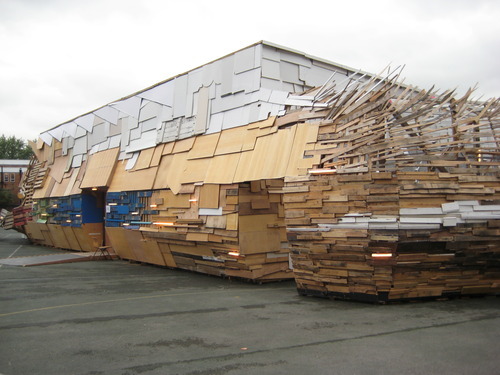
These days, architects are versatile in reclaimed wood, pallets and sustainable means of construction - like the crates our parents used as bookshelves when we were kids or the pallets used by permaculture gardeners to build city allotments today - : pioneers of situationist architecture, Exyzt, Collective ect., Raumlabor, Constructlab use collective involvement and flexible, low-tech material.
 © Exyzt
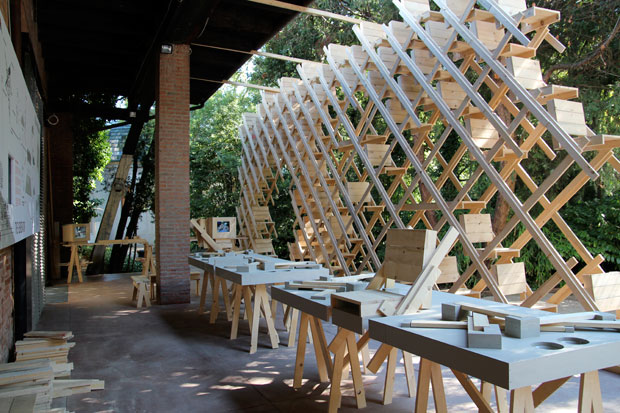
In Portugal, in Guimaraes, Exyzt is leading construction workshops for Fine art and Architecture students using traditional ways of building. Students are not sitting behind computers but building a crafted platform, with bespoke chairs, to be used for a Laboratorio de Curadoria. The platform is built in a way that puts the human hand and the human brain at the centre of architecture : the design doesn't rely on machines here.
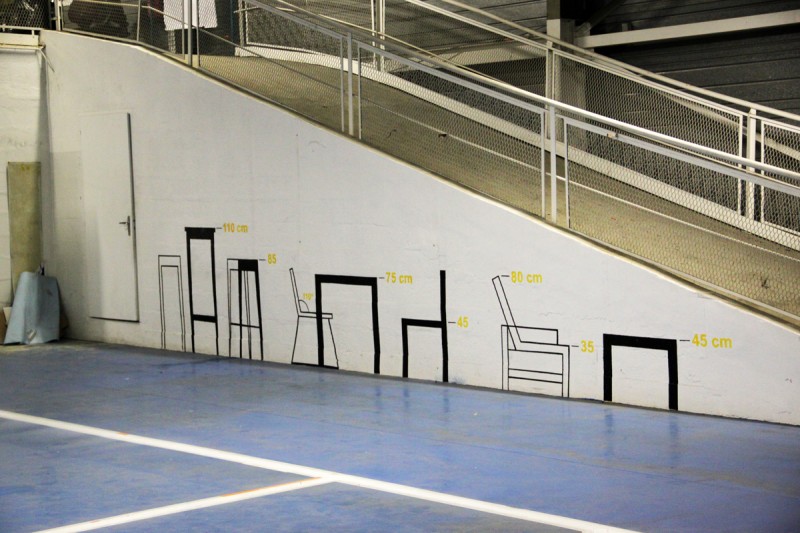
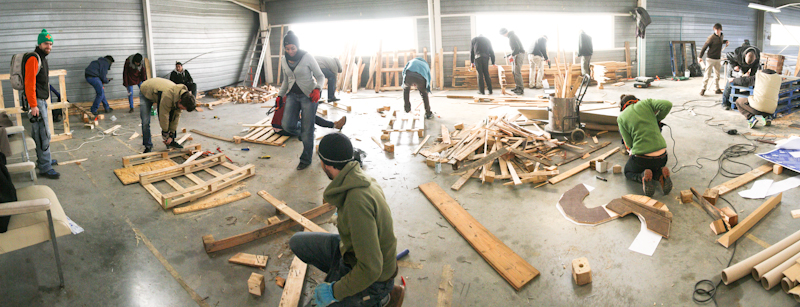 © Collective etc., La piscine [taken from Collective etc. web page]
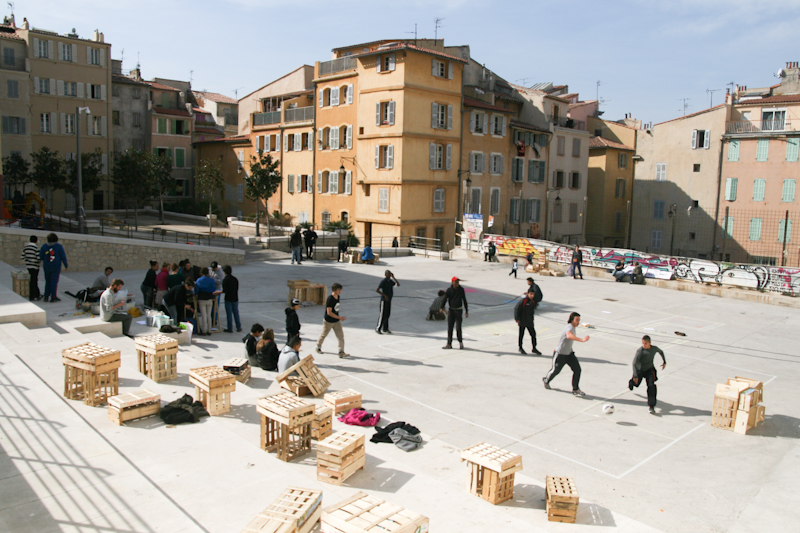
© Collective etc., Marseilles - Le Panier's area nomadic workshop [taken from Collective etc. Facebook page]
In Grenoble, Collectif etc. runs collective workshops, at La Piscine, empowering locals to 'self-build' low-cost, DIY furniture, investigating for a better habitat. In Marseilles, they bring the nomadic urban intervention to the residents of Le Panier, using wooden pallets, to share concerns about the regeneration of their neighborough.
Constructlab (Build your own shelter, intervention in Annecy's Art & Design school) or Raumlabor similarly use crate-looking planks as staircases, viewing-sitting platforms, partition-walls, to host temporary community projects. Raumlabor's ingenious design (workstations and chairs) encourages viewers to 'learn by doing', by building collectively.
The collective also explored the idea of 'sustainability' by pilling up discarded furniture, doors and windows at The big crunch.
 © Raumlaborberlin [taken from Raumlabor's web page]
In 2010, Oikos proposed to re-use reclaimed wooden planks and pallets to build The Jellyfish Theatre. 'Focusing, on energy-efficiency, co-operation and human-scale', creating performative and temporary constructions, making space and giving space (back) to the community.
© Raumlaborberlin [taken from Raumlabor's web page]
In 2010, Oikos proposed to re-use reclaimed wooden planks and pallets to build The Jellyfish Theatre. 'Focusing, on energy-efficiency, co-operation and human-scale', creating performative and temporary constructions, making space and giving space (back) to the community.
© Oikos project [taken from Oikos flickr]

© Raumlaborberlin
In Raumlabor's apocalyptic scenarios, capitalism and global litter threaten mankind survival; a temple of discarded doors and chairs is crawling towards the Darmstadt's Theatre to fight/ escape, the imminence of a disaster.

© Raumlaborberlin
It echoes the Merzbau, when Kurt Schwitters transformed his home into an expansion which was growing vertically and out of control. Here the threat is still global : will humanity use its creative power to rise out of chaos or will the sterile processes of our political and economical world swallow the Earth until space reverses onto itself ?

© Raumlaborberlin
Built from the left-overs of mass-consumerism The Big crunch investigates new social territories, expands organically from inside out, assembles domestic rubbish to create a physical space for social gathering.

© Raumlaborberlin/ photo © Max Tomasinelli
Same alternative at the House of contamination, an architectural model for Artissima's cultural centre and indoor city. By skillfully piling-up the leftovers of mass-consumption (plastic bottles, packaging, advertising papers, fabrics ...) to create the skeleton of the House, the walls reveal layers of trash like archeological stratas of the present.

© Raumlaborberlin/ photo © Max Tomasinelli
We are invited in the Palace of our rubbish : there litter holds the potential to shelter us, fridges are book shelves and rejected clothes cover the floor of a garage. A corridor bathed by a breeze gently opens and closes parts of a translucide curtain, where compartimented areas host a program of dance, urbanism, cinema, education, litterature, design.

© Raumlaborberlin/ Max Tomasinelli
The Skywall which dominates the whole of the architectural intervention acts as a tolerant type of panopticon : anyone can place himself or not in the tower of control, but can't intervene on what is happening in the rooms of the first floor.
Overlooking the city from this observatory platform, we face the reality about its potential future : if we all control the machine, how to make it run now ?
© Raumlaborberlin © Max Tomasinelli
When materials, people and programs collide, interesting moments of ambiguity and tension lead to negotiations over needs, desires and purposes, and hopefully allow new forms of collaboration to develop. We consider this negotiation process an essential part of the production public space. New forms of collaboration spark the hope for a different and better world, for a human overcoming of the endzeit scenarios. Again the future is uncertain. Let’s contaminate radical individualism. Collectively is not a choice, but a necessity.
Raumlabor

 Terrasse-platform, St-Jean-en-Royans, 2010 © Exyzt © De L'aire/ Photo © Emmanuel Gabily
For De L'aire's residency, Chaux Devant, Exyzt gives a Terrasse-platform, an alternative to HLM halls where children meet and chat, an enclosed bench and decking area as a response to the cementing of play areas in the city and to reinforce convivial space.
 Chaud devant, St-Jean-en-Royans 2009 © Exyzt
The second residency, Chaud Devant ! gives the community a meeting point, a hot spot to share stories and a pizza by the warmth of an oven on wheels. The mobile oven and the terrasse-platform are built out of wooden planks which mirrors the village's past wood industry and the inhabitants' involvement as work force in its factories.

Les Fougeres, 2009-2011 © Exyzt © De L'aire/ photo © Emmanuel Gabily
With the third residency, Exyzt is assembling an Autonomous Space from the leftovers of the HLM Les Fougeres' demolition : doors, windows, bathtub ... to build a Kiosk for the community.

 © Exyzt © Bogusz Bilewski
In the middle of a busy roundabout in Warsaw, a UFO has landed. This temporary recycling of a disused public fountain by Exyzt borrows from the poetics of spaceships and crop circles.
© Exyzt © Bogusz Bilewski
In the middle of a busy roundabout in Warsaw, a UFO has landed. This temporary recycling of a disused public fountain by Exyzt borrows from the poetics of spaceships and crop circles.
If the Unexpected Fountain Occupation provokes a state of wonder, the closer encounter of the third kind will mostly offer to meet one's neighbour, a passer-by, the other.

© DÄG
Exyzt's streetwise visuals call to the city's attention : DÄG's minimalist, effective graphic style is easily spotted by the local community and guides passers-by to sites of interventions.
This time Salut a toi Vars'ovni (Warsaw's salute), DÄG recalls iconic anarchist hymn Salut a toi from cult band Berurier Noir.

© Exyzt
Exyzt's UFO is made of scaffolding and wooden planks which are easy to find, assemble and recycle. The space isn't hidden as it was the case with the Dalston Mill in London but an existing public footpath easy to access.
Those who gather at the fountain define its concept - a space for social interactions and visitors who influence its functioning. The UFO isn't conceived to apply beautiful architectural principles but to answer social and living practicalities, an hotel, a bar, showers, swimming pool, so the crew can temporary live on site. Sleeping, washing, cooking and networking are essentials components of Exyzt's projects, buildings are less concerned with design than with offering a freestyle experience : this time, a Temporary Autonomous Zone for the people of Warsaw.