Showing posts with label Drop city. Show all posts

6 June 2012

The freedom zone


The zone of freedom lives at the edges of wilderness, at the periphery of industrial areas and council estates, along train tracks and desolate lands, in factories and buildings that escape central agendas to become spontaneous playgrounds, and sometimes also on sacred lands.


Free Stonehenge encampment, UK

To implement the control, zoning and conpartimenting of these populations, local authorities abolish the right for free gathering (suppression of the Free festivals) : subcultural nomads are expected to redirect themselves towards the spaces of (state) convenience - the Mall, the Funfair.


Enchanted forest, Texas - 2006 © Alec Soth

But they don't.
Once that breathing zone is reduced by squatting laws or controlled by regeneration politics, some leave for the Never never lands.

[IMG]
The last convoy to Stonehenge - Battle of the Beanfield, UK - 1984

The spaces of play and freedom become flexible, resilient, temporary; communities live in transient mode to avoid the encirclement. 

Morison_04a


The free parties get more organised, less easy to track (endless hunts for remote gatherings, truck convoys at the far ends of western and eastern borders). 

Investigating new lands, new living patterns provoke the context we aim to flee - Michael Reynolds spends as much time by-passing building laws to keep his earthships legalised than building them - but pioneers open the doors to social change. Ignoring the alienation of the state machine, the 60's give birth to resilient architectural practices. 


Archigram's Monte Carlo and Bournemouth Projects - published in Architectural Design, August 1971. Photo: Tatjana Schneider


© Archigram photo © Tatiana Schneider taken from Spatial agency webpage

Buckminster Fuller informs the building of Drop city, a temporary settlement built from scratch, Archigram influences a socially engaged architecture for a playful city. Freedom activists, artistic and intellectual movements investigate new forms of deterritorialization to preserve autonomous zones in the city

Southwark Lido 2008


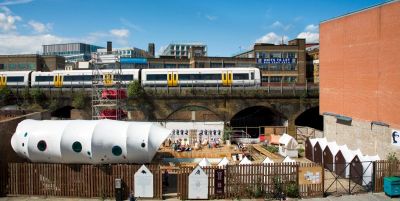
Southwark Lido, 2008 © Exyzt / Sarah Muzio 

Architectural collectives like Exyzt devise urban spaces that invest the zones of control : benefiting from a pause in the development frenzy, their events replicate, duplicate, multiply themselves, disappear and re-appear, putting the off-grid back on the map. Their temporary appearances keep political agendas, advertising and consumerism off site while giving space for play and gathering.
At Campo Boario in Roma, Stalker opens a borderless, visa free zone to homeless groups and transitory immigrants. A space that temporarily succeeds to abolish the rules imposed by Shengen (a legal space, 'illegally squatted but legitimised by institutional and media support'). 

In order to escape the societal rules and spatial boundaries of the state, in essence, the zone of freedom remains a fleeting momentum charged with the spirit of now, an urban void filled with shared experiences and memories.


Campo Boario - Roma 1999 © Stalker


9 April 2012

The breathing zone


© Bellastock photo © Felicie Botton [taken from Popupcity web page]

Bellastock mixes recycled plastics with wind power and human breath to build a temporary cityThe desertic landscape inhabited by one geodesic structure and bubble-like shelters bridges the gap between the utopian appropriation of new territories at Drop city, the pop-up installations of Raumlabor - spacebuster - and the experiments of Buckminster Fuller


© Bellastock photo © Guy Vacheret

The project which sounds light and simple also involves the complex logistics of living from scratch (mobile kitchen, sheltered dormitory spaces, waste recycling and agency of hundreds of architects and artists).

A house of Hans-Walter Müller (outside)
© Hans walter Muller

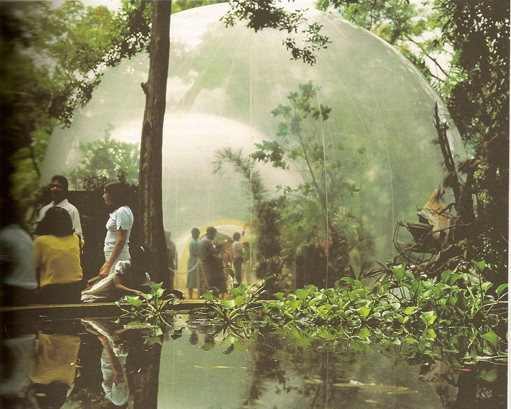
Bellastock cites the pioneer of inflatable architecture Hans walter Muller as influence : his work embraces the idea of nomadic, moving, walking architecture for a transient man; like Gilles Clement's idea of a moving, walking garden in landscape design.


© Bellastock / photo © Guy Vacheret

Bellastock's bubble city has a TAZ quality : a fleeting, poetic redefining of the social contours of space informed by working and breathing; the re-invention of the spatial environment as a place in between, a meeting point between blurred domestic and social dimensions.

17 July 2009

Spaceship Earth and the designer Guru


© Buckminster Fuller Institute / Director unknown

Buckminster Fuller meets the Hippies is a rare footage showing the architect in conversation with a group of Hippies from the west coast. It was projected at the Barbican centre as Part of Radical Nature thanks to Liam Young, co-founder of Tomorrow's Thoughts Today. 
The film which refers to design, geodesic structures or spatial agency becomes an insightful and captivating journey about metaphysics and the purpose of man on earth.


Dome over Manahattan - 1960 © Buckminster Fuller Institute/ Shoji Sadao

The assumption that we are on earth not to consume but to learn becomes in Buckminster's fashion the vision that humans are astronauts and earth the spaceship; technologies are tools to drive the spaceship and not instruments of fear.


Drop city
Holiday celebrations at the Dome Village. Photo: Ronda FlanzbaumDome Village, LA (circa. 1994). Photo: Craig Chamberlain
LA Dome village - 1994 © Dome village/ photo © Craig Chamberlain © Ronda Flanzbaum

His faith in (utopian) technology is celebrated with the geodesic domes that can be erected as high as needed : lightweight and low cost, they are put to the test by the hippie commune of Drop city
The geodesic dome will then inspire the radical LA Dome village which shelters homeless people.


Counter communities - 2003 © Croy & Elser

A second footage, Counter communities by Croy & Elser which exemplifies the influence of utopian architecture with more counter-cultural experiments - Arcosanti, Nader khalili's earth shelters -, mostly concentrates on Michael Reynolds's earthships. 
Challenged by the californian building legislation, Reynolds brings the concept of his earthships (build in situ from recycled, natural, local material) to tsunami's inflected areas in India, to show locals how to erect emergency shelters.


Once upon an island : utopian cowboys, guru astronauts ...