Showing posts with label Exyzt. Show all posts

6 June 2012

The freedom zone


The zone of freedom lives at the edges of wilderness, at the periphery of industrial areas and council estates, along train tracks and desolate lands, in factories and buildings that escape central agendas to become spontaneous playgrounds, and sometimes also on sacred lands.


Free Stonehenge encampment, UK

To implement the control, zoning and conpartimenting of these populations, local authorities abolish the right for free gathering (suppression of the Free festivals) : subcultural nomads are expected to redirect themselves towards the spaces of (state) convenience - the Mall, the Funfair.


Enchanted forest, Texas - 2006 © Alec Soth

But they don't.
Once that breathing zone is reduced by squatting laws or controlled by regeneration politics, some leave for the Never never lands.

[IMG]
The last convoy to Stonehenge - Battle of the Beanfield, UK - 1984

The spaces of play and freedom become flexible, resilient, temporary; communities live in transient mode to avoid the encirclement. 

Morison_04a


The free parties get more organised, less easy to track (endless hunts for remote gatherings, truck convoys at the far ends of western and eastern borders). 

Investigating new lands, new living patterns provoke the context we aim to flee - Michael Reynolds spends as much time by-passing building laws to keep his earthships legalised than building them - but pioneers open the doors to social change. Ignoring the alienation of the state machine, the 60's give birth to resilient architectural practices. 


Archigram's Monte Carlo and Bournemouth Projects - published in Architectural Design, August 1971. Photo: Tatjana Schneider


© Archigram photo © Tatiana Schneider taken from Spatial agency webpage

Buckminster Fuller informs the building of Drop city, a temporary settlement built from scratch, Archigram influences a socially engaged architecture for a playful city. Freedom activists, artistic and intellectual movements investigate new forms of deterritorialization to preserve autonomous zones in the city

Southwark Lido 2008


Southwark Lido, 2008 © Exyzt / Sarah Muzio 

Architectural collectives like Exyzt devise urban spaces that invest the zones of control : benefiting from a pause in the development frenzy, their events replicate, duplicate, multiply themselves, disappear and re-appear, putting the off-grid back on the map. Their temporary appearances keep political agendas, advertising and consumerism off site while giving space for play and gathering.
At Campo Boario in Roma, Stalker opens a borderless, visa free zone to homeless groups and transitory immigrants. A space that temporarily succeeds to abolish the rules imposed by Shengen (a legal space, 'illegally squatted but legitimised by institutional and media support'). 

In order to escape the societal rules and spatial boundaries of the state, in essence, the zone of freedom remains a fleeting momentum charged with the spirit of now, an urban void filled with shared experiences and memories.


Campo Boario - Roma 1999 © Stalker


24 September 2011

My HLM is hot


Terrasse-platform, St-Jean-en-Royans, 2010 © Exyzt © De L'aire/ Photo © Emmanuel Gabily 

For De L'aire's residency, Chaux Devant, Exyzt gives a Terrasse-platform, an alternative to HLM halls where children meet and chat, an enclosed bench and decking area as a response to the cementing of play areas in the city and to reinforce convivial space.


Chaud devant, St-Jean-en-Royans 2009 © Exyzt 


The second residency, Chaud Devant ! gives the community a meeting point, a hot spot to share stories and a pizza by the warmth of an oven on wheels. The mobile oven and the terrasse-platform are built out of wooden planks which mirrors the village's past wood industry and the inhabitants' involvement as work force in its factories.


Les Fougeres, 2009-2011 © Exyzt © De L'aire/ photo ©
Emmanuel Gabily 

With the third residency, Exyzt is assembling an Autonomous Space from the leftovers of the HLM Les Fougeres' demolition : doors, windows, bathtub ... to build a Kiosk for the community.


6 August 2011

Unexpected Fountain Occupation


© Exyzt © Bogusz Bilewski

In the middle of a busy roundabout in Warsaw, a UFO has landed. This temporary recycling of a disused public fountain by Exyzt borrows from the poetics of spaceships and crop circles.
If the Unexpected Fountain Occupation provokes a state of wonder, the closer encounter of the third kind will mostly offer to meet one's neighbour, a passer-by, the other.


© DÄG

Exyzt's streetwise visuals call to the city's attention : DÄG's minimalist, effective graphic style is easily spotted by the local community and guides passers-by to sites of interventions.
This time Salut a toi Vars'ovni (Warsaw's salute), DÄG recalls iconic anarchist hymn Salut a toi from cult band Berurier Noir.


© Exyzt


Exyzt's UFO is made of scaffolding and wooden planks which are easy to find, assemble and recycle. The space isn't hidden as it was the case with the Dalston Mill in London but an existing public footpath easy to access.
Those who gather at the fountain define its concept - a space for social interactions and visitors who influence its functioning. The UFO isn't conceived to apply beautiful architectural principles but to answer social and living practicalities, an hotel, a bar, showers, swimming pool, so the crew can temporary live on site. Sleeping, washing, cooking and networking are essentials components of Exyzt's projects, buildings are less concerned with design than with offering a freestyle experience : this time, a Temporary Autonomous Zone for the people of Warsaw.


1 August 2009

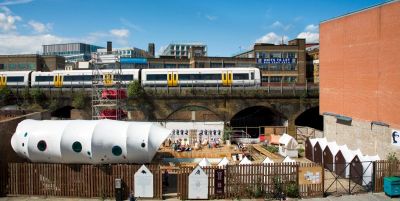
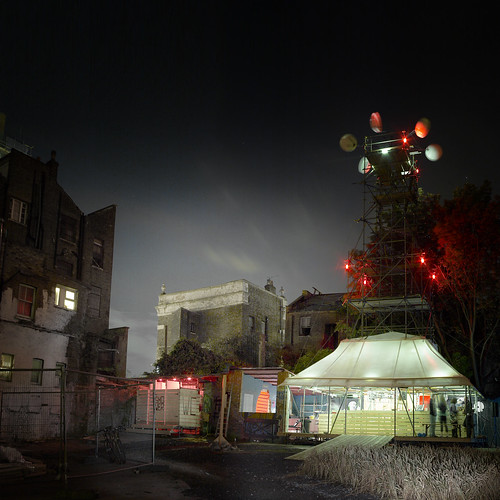
Dalston Mill


DALSTON MILL 09 by exyzt.collectif.

Dalston Mill - 2009 © Exyzt collective

Passing the threshold of the Mill provokes an instant sense of peace and loss of urban time (click for photos).
It was built by Exyzt to re-stage Agnes Denes's Weatfield and was shown as part of Radical nature at the Barbican centre.  
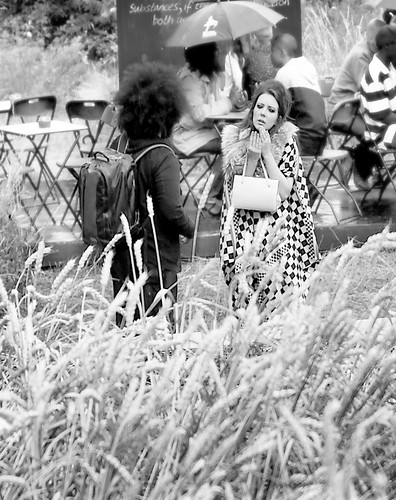
The Mill is a busy hive for the people of Dalston : a DJ passes-by to use the sound system, a designer cycled with her mobile kitchen to help baking cakes, pizzas are being cooked by Exyzt's architects and parents chill out on Southwark Lido deck chairs while their children run up and down the garden's alleys. 
Hidden from the city's surveillance, the Mill is a shelter against the noise and pollution of Dalston junction, reclaiming the land has common space. 


© Analucia Feracci

It isn't an escapist hideout but an invitation to make things happen : a city within the city, with bakery, workshops, bar, sound system and its own currency, the Dalston slice, baked and traded for goods and services to link with local traders - an experiment by the Collaborators guide.
The Mill is hanted by the reggae scene of the Four Aces Club from the 60's, now demolished by promoters, a context which reinforces the need for a social hang-out.


DALSTON MILL 05 by exyzt.collectif.
© Exyzt collective flickr

The Mill is made of a succession of scafoldings to mirror the building site opposite its entrance. The an-architectural form has turned into a living space with tents and showers for the architects of Exyzt.
The site exists above a disused train track : a line of gravel delimits the area that belongs to the City Council while the wheatfield draws the part that belongs to the owner of the adjacent superstore. Sandwiched between abandoned buildings and a car park, that space is yet too narrow to attract developers.

DALSTON MILL 08 by exyzt.collectif.
© Exyzt collective flickr

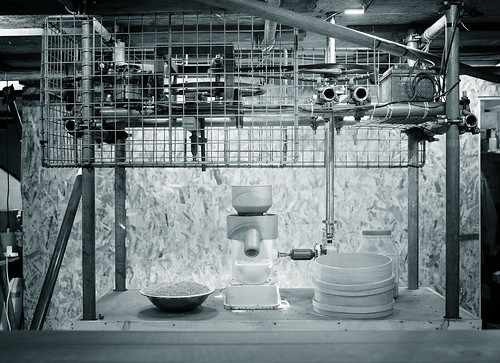
The Mill also functions in an organic manner : the turbines produce electricity for the bar/ sound system, distributing wind energy in a stable manner, bringing nothing between the natural source of energy and the process of grinding. Like Tibo from Exyzt points out 'no need to use solar panels on a house roof if we use hot running water pipes - why rely on electricity always ?'.
In the context of Radical Nature, which explores the relationships between man and the environment, the Mill gives 
local people a temporary autonomous space to celebrate human interaction and urban life. 


Thanks to Tibo Labat and Nicolas Henninger