Showing posts with label Non-space. Show all posts

1 February 2013

The watchers being watched

Untitled (Predators; Indian Springs, NV), 2010, C-print © Trevor Paglen, Courtesy of Galerie Thomas Zander, Cologne and Altman Siegel Gallery, San Francisco.
Untitled (Predators; Indian Springs, NV) © Trevor Paglen © Galerie Thomas Zandler

A monotonous sky is interrupted by a blurry aircraft on its left corner; a forest landscape spreading wide in the horizon reveals scintillating but undefined architectural objects in its middle part. 
The main intrigue in Paglen's photographs comes from their distant viewpoint : what are we watching ? where is the scene taken from ? where is the viewer positioned in relation to the event ? 
Who is watching what ? 

They watched the moon © Trevor Paglen © Altman Siegle gallery

The skies photographs Predators reveal the secret activities of Drones : Paglen uses data from amateur satellite watchers to track and photograph classified aircrafts - spy satellites and predator drones -, photographing them photographing him, watching those who are watching us as he puts it.
In They watched the moona super strenght telescope reveals a 'listening station', a top-secret U.S. governmental site, a covert base so remote it cannot be seen by unaided civilian eye from any point on earth.
Physical intersection between Earth and the Universe, the station listens to communications from the Earth as they escape towards the moon and bounce back towards the Earth, in an auditive mise-en-abyme. 


10 January 2010

Chasing Napoleon

Chasing Napoleon, Palais de Tokyo, 2010


Unacabine (and the original in an FBI basement) © Kusmirowski

Why is Theodore Kaczynscki's manifesto Industrial Society and its Future, kept secret by american services alongside his memoirs ? what frightens so much the american system now he is strictly isolated under police control ?
To understand america's public ennemy,The Unabomber Book Collection by Dora Winter's collective builds up the escapist strategies while Robert Kusmirowski's Unacabine give existence to Kaczynski's flee into the wild.
The presence of his shed in the gallery space of The Palais de Tokyo challenges its legitimity : w
hat makes the difference between the shed he lived in, the lived object, and the fake one ?

The door that asks to be opened, the incapacity to enter, deepen the mystery : the enclosed house encapsulates the uncanny nature of radicalism and extremism as a choice of life, freezing a time forever gone and inaccessible so that Kaczynski's motivations remain terra incognita, his borderline personality won't be framed.
The imperceptible nature of truth, frontiers between real and unreal, are reinforced by an empty plinth on the side of the shed where Thomas Friedman has placed A curse. The aura of the shed and the invisible malediction mirror each other's faith in the tangibility of the unseen.


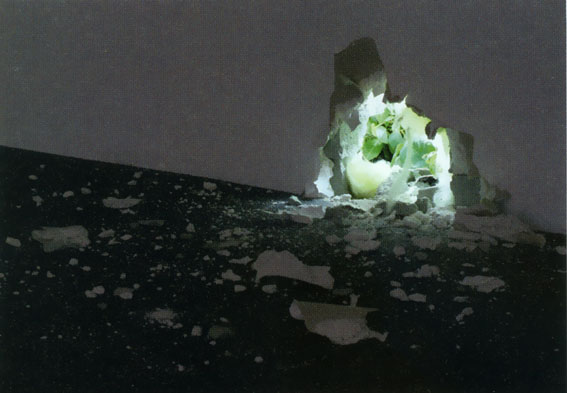
Spider Hole © Christoph Buchel © Dazed & Confused  

Further away, we can climb inside Christoph Buchel's Spider hole and experience how to hide - like Saddam Hussein. 
Through the exhibition, escapists flee via devices - shed, hole, airvent, drain -, remain invisible from surveillance and control.

ryan-gander-nathaniel-knows-2003-2009-materieux-divers2
Nathaniel knows © Taro Nasu © Ryan Gander

Their disappearance suggests the existence of parallel dimensions : Ryan Gander breaks into the Palais de Tokyo as if coming from
an heterotopia of wilderness, a lost hedonist paradise as the title Nathaniel knows suggests (Andre Gide, Les nourritures terrestres). 


Vorkuta © Micol Assael © Andre Morin

After the critical reference to american capitalism and Napoleon's imperialism, Micol Assael's re-enactement of a communist gulag mirrors the collapse of all systems : in the absence of the worker, Vorkuta's engine is empty of its potency and those who stood in the way of the regime have disappeared.

With Paul Lafolley who explores spatial dimensions, the escape from the constraining boundaries is total. Utopia becomes a suspension between the possible and the impossible, the invisible - or para-normal - recalls the existence of multivers and their "total non-existence". When he affirms having temporary left our physical world during an electroshock in 1961, it somehow reflects Kaczynski's enforced mind control during his C.I.A. funded studies as we wonder how much the stress tests impacted on his sanity.
The chosen year 1977 - that according to the Palais de Tokyo refers to a time when the Unabomber survives by himself in his cabane in the Montana, or when Paul Laffoley finishes his odyssey, refers above all to a time zero - the birth of punk -, an apolitical, subversive dimension and collapse of values.
Now if we go back to the beginning of the show,
For the dogs (...) a prelude for piano by Erick Satie and David Allen is being played on such high frequency that it can't be heard by human ear : a sound piece, and a wave field that we didn't perceive, which does exist outside our realm of senses.


5 November 2009

Walking the void


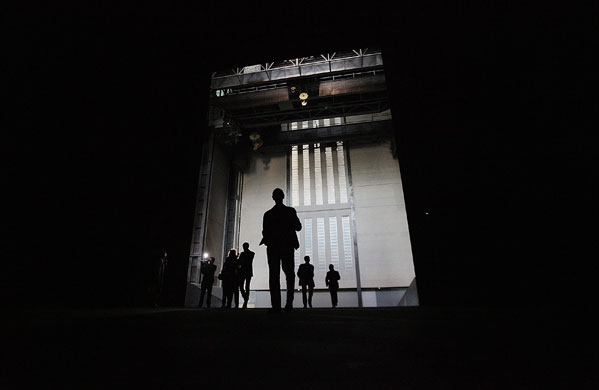
How it is © Miroslaw Balka photo © Getty images


Miroslaw Balka's gigantic box is set-up at the end of the Tate hall. At first, the mind questions the need to reach the ramp that leads to darkness, the positioning of Balka's object creating a spatial threshold. The steel container mimicks the Tate's building so it feels like stepping inside its inside replica, inside a non-space.
The engulfment in darkness announces an experience of the limitless, a fall into the Abyss : once there, we can barely touch ground as if floating in space. Like quantum physicists  observing black holes, spending days studying micro particles of nothingness to the point that their eyes see the void everywhere, our feet believe there is nothing under them, our hands scrutinize the rest of the dark ahead.

Losing track of physical boundaries, we rely on other viewers' fantomatic silhouettes to see further. And this is where the Total experience makes sense, in the humanity the darkness reveals - relying on others as boundary.

Miroslaw Balka: Miroslaw Balka's installation How It Is in the Turbine Hall at Tate Modern
photo © Peter Macdiarmid © Getty Images

When we reach the softness of the last wall and realise the cavity has an end, we also feel the need to turn back and escape. The visual metaphor created by the ray of light at the exit mirrors the false reassurance we can now leave the container (the entrance never being an exit).
Beyond phenomenology or metaphysics, the container confronts our own consciousness, humanity's shared darkness, one's responsibility and place in the world as it is revealed at the moment of death maybe.
Balka refers here to Beckett's Pimp as the other encountered in the void : for the economy of mean, the bare simplicity in face of the absurd.
If How it is depicts a Total space, a purgatory, a place of suffering and purification, it is also concerned with a timeless spatiality in relation to the human body and soul. 
When interviewed, Balka stresses how 'insignificant' things - the simple act of sweeping a floor with an ancient broom, the bells that always ring as if to say "this is a special moment in time" or the traces left by his grandmother's praying body on his studio's floor - often carry deep symbolic meaning. 
What is reinforced here is that his work is always concerned with the beauty and fragility of human presence.


Balka's work is charged with the memory of the Jewish ghetto of Otwock, his hometown.


23 October 2009

The museum of incest


The Museum of Incest : A Guided Tour © Neue Alte Brucke © Simon Fujiwara
photo © Anna-Lucie Feracci


What is the link between the first man on earth and the history of incest ? Could human existence be reduced to a tale of transgressive eroticism ? 
Simon Fujiwara's slide presentation transports us into a parallel reality made of whimsical thoughts, witty accounts of intimacy. The fluidity of his speech, the constant use of digression create a sense of de-construction of the narrative, an alternative auditive space, an heterotopia of language.
Fujiwara's imaginary architecture exists as a non-object, a non-space. A museum which artefacts don't really exist, since incest is taboo, which focuses on archeology, a science that isn't accurate, can only refer to a form of invisibility. 
The art of Fujiwara is the art to bewitch, the art to tell stories.


20 October 2009

The vacuity of the Art Fair


Double fond 
© The Fair Gallery

For Frieze 2007, The Fair Gallery invited Aurelie Voltz to curate its stand : refusing the imposed model of commercial art environment, she turned the space into a domestic room, a jigsaw set-up inspired by the symbolics of Bachelard's Poetics of space with different artists' works interlaced around the themes of memory and intimacy.
Its title" Double fond " seemed to twist the conventional gallery's aim giving the art objects a second life. From time to time, a mother came on the stand to teach her young child to walk, a non normative, nearly invisible performance by Roman Ondak that positioned Double fond outside of the material realm.


Enigma 2 © Reena Spaulings

For Frieze 2009, Reena Spauling Gallery showcases Claire Fontaine's famous neons : their absence leaving space for a billing note.
Claire Fontaine reduces the contemporary art scene inspirations to dinner parties' conversations, a motto that borrows from Guy Debord's anticapitalist ideas and from the Situationists' fake exhibitions, a concept successfully transcended in Reena Spaulings' minimalists canvases, Enigmas 3 & 4 : Table cloth for Atforum dinner, Art Basel Miami.
Since Reena Spaulings duplicated the original concept in numerous copies, it proved financially successful - the anti-consumerist, anti-bourgeois objective also reaching a place counter-productive to what is initially claimed.


The great white hope © Marisa Argentato & Pasquale Pennacchio © T293

T293a gallery which stand is intriguingly seductive in its minimalist choice is also part of Frieze 2009. 
T293 is designed like an empty shop by artists Marisa Argento and Pasquale Pennacchio, mounted like a platform of shelves and dressed with neo-conceptual neons. There is no work on display, the artists are represented by their catalogues : like Claire Fontaine and her detournements that challenge the notions of authorship.
The aim of the gallery is to redefine ways of exhibiting and viewing art, squeezing the viewers' imagination since the context announces an unseen content. 
One can think of the vacuity of the art fair, of the collecting of objects devoid of their essence once serving the sole purpose of being sold, their absence-presence on the booth questioning their newly gained status. 

Special thanks to T293 gallery